
If Life on Earth Were Dev or Test
And Home Were Prod at End,
One Shot, One Check To Meet the Spec,
One Push To Prod, No Mend.
If Home on Earth Were Life in Prod
Where Good for God We Grow,
The Path We Need, With God We Seed,
Each Day We Reap and Sow.
This poem is about two ways of pursuing heaven. Read on to discover its meaning.
Two Understandings of Heaven
In modern Christianity, the heavenly goal is typically understood as the individual soul getting to Heaven, as opposed to Hell, after death. But first century Christians had a very different understanding—that God’s goal is to reunite Heaven and Earth for everyone (see Time.com: The New Testament Doesn’t Say What Most People Think It Does About Heaven, BibleProject: Heaven and Earth).
My poem tries to capture both views using an unlikely metaphor from Information Technology. I borrow terms like Dev, Test, and Prod (environments where systems are developed, tested, and deployed to production) as metaphors for how we might think about earthly and heavenly domains.
Waterfall vs. Agile: A Metaphor
The poem also borrows two software development strategies: waterfall and agile.
Waterfall projects do all the planning, designing, and testing upfront, before one single, monumental deployment. They often fail because developers don’t fully understand the requirements or rely too much on their own judgment.
Agile projects work differently. Developers and owners maintain ongoing dialogue about what’s needed. The system is planned, developed, tested, and deployed gradually and iteratively, with constant questions and adjustments rather than isolated interpretation.
So how might this be relevant to our understanding of heaven?
When Heaven is Seen as Waterfall Projects for Individuals
In the waterfall approach, each person tries to perfect their heart alone, hoping they “pass the test” at death. Then the next person starts over from scratch. The same project repeats endlessly with no collective learning or progress. It’s each person for themselves.
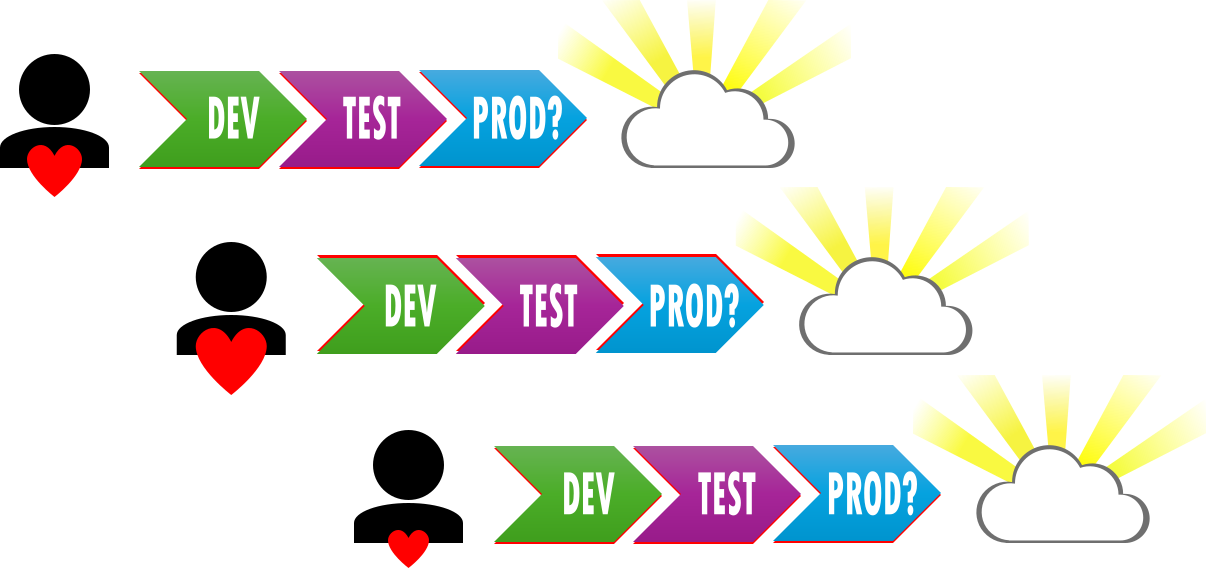
Individual persons trying (or not trying) to “make it” to Heaven: Developing their souls while living, Testing their souls at the pearly gates, and going to Production (Heaven) if passing the test
The Agile Approach: Building Hearts Together
In an agile approach, we work together with God in ongoing dialogue, gradually transforming hearts across humanity, generation building on generation. We “reap and sow” continually—each day, each act of love building Heaven on Earth, bit by bit.

Generations of people and their hearts engaged with God in agile (iterative, incremental) improvement, gradually realizing the Heaven that God wants. (God’s name is depicted in Paleo Hebrew as was done in some of the Dead Sea Scrolls.)
A Different Way of Thinking
The waterfall vs. agile metaphor suggests different ways of thinking about our spiritual objective:
| Individual Waterfall Projects | Collective Agile Alignment |
|---|---|
| Each person alone with God | Community in dialogue with God |
| Focus on my salvation | Focus on transforming all hearts |
| Starting over with each person and generation | Building on previous progress |
| One-time judgment for each person | Ongoing transformation |
| Heaven as escape | Heaven coming here |
| Following rules independently | Learning together |
| Success measured at death | Success measured by love on Earth |
The Software of the Spirit
Think of the human heart as the software of the spirit—the operating system or application platform that enables Heaven on Earth. When human hearts run on love, forgiveness, humility, extreme generosity, and stewardship for the earth, Heaven becomes possible here.
If there is truth in this proposition, then it doesn’t make sense for individual people to pursue Heaven as separate waterfall projects for themselves. I mean, isn’t that like trying to install the perfect software on your desktop computer before it dies on you? The agile approach says: “Let’s work together with God to gradually upgrade the collective human heart, learning and improving across all people and all time.”
For those of you in the software industry, you know that our entire industry has been gradually moving its focus from individual workstations to the Cloud, which is the ultimate context for agile transformation. Do we need to do the same kind of thing with our hearts and spirit?
A Possibility Worth Exploring
My poem’s first stanza describes waterfall thinking—Earth as testing ground, Heaven as final deployment, one shot to get it right. The second describes agile thinking—Earth as the place where we’re already working with God, planting and harvesting together, day by day.
Of course, no metaphor is perfect, and as I have suggested elsewhere, we may have little clue what truth is like in the spiritual realm (https://www.darndestdabbler.org/2024/08/26/the-after-womb-a-parable/). Nevertheless, there may be some value in considering whether an agile, collaborative heart-rebuilding is possible and what it might require of us.
Are we in ongoing, honest dialogue with God? Are we learning together across communities and generations? Do we need to focus more on building compassion? Should we reconsider how Christians engage culture? Can we learn from ancient communities that sustained themselves differently? Should we stop obsessing over individual salvation and focus on living like Jesus each day? Or do we simply need to surrender ourselves to God?
Would it be so outrageous to think that God wants us to take responsibility (though not independently) in making things right? That working with God to gradually bring Earth and Heaven (back) into alignment would be a better relationship-building and love-fostering exercise than God doing it all alone?